How to Play - Broken Alliance | Grinning Demon Games
THE GAME
Broken Alliance: Soulshards ECG is a high tactics expandable card game for 2 players. Each player uses their own deck assembled from their favorite cards. During the game, players take on the role of a captain of an alliance guard. Your job is to defend your cities while decimating the resolve of the other player's alliance in order to get ahead in the ongoing war. Each player will obtain and play cards from their deck which represent their forces and resources to defeat the opposing city.
ZONES
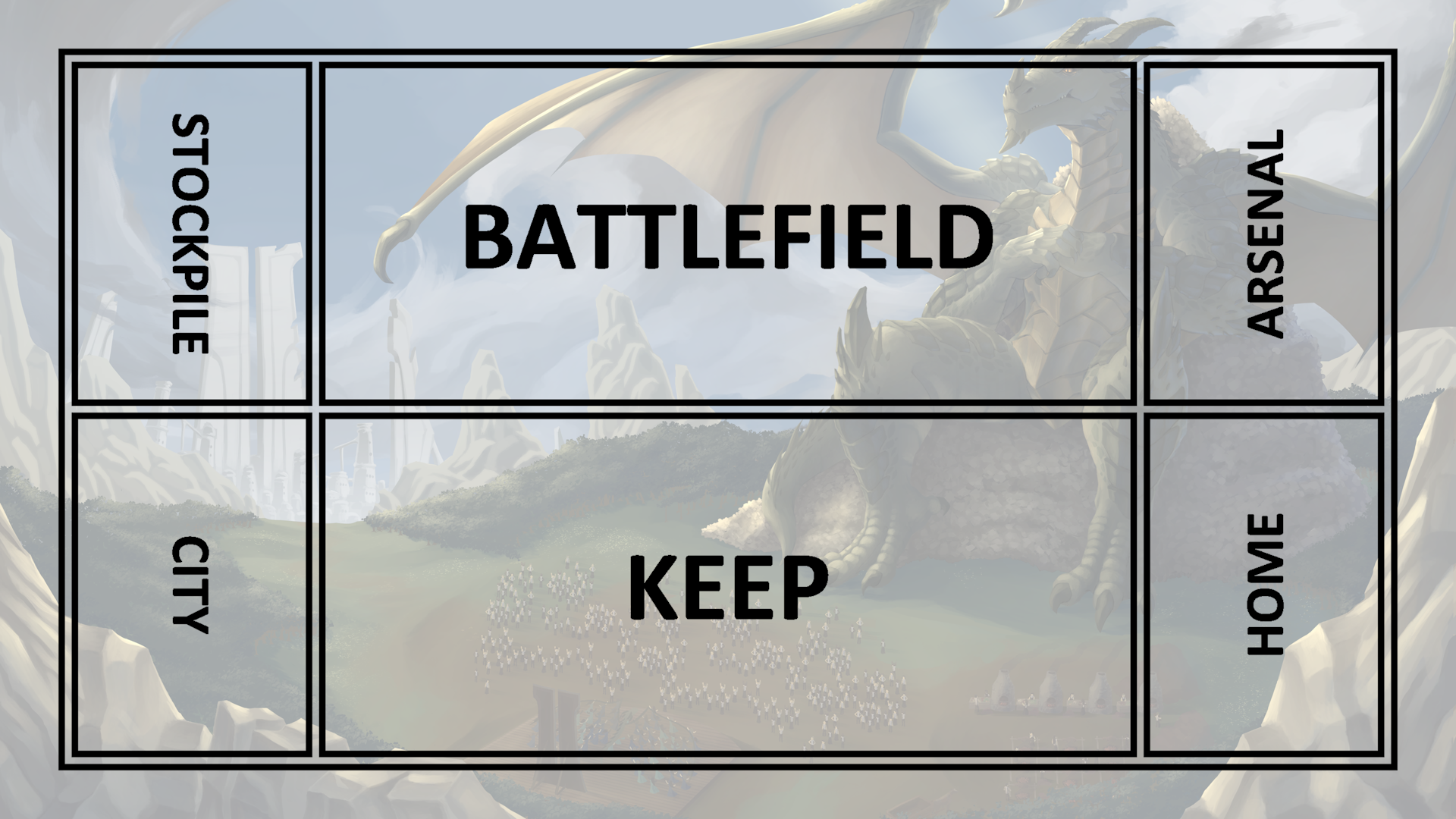
During the game, cards are placed in one of 7 Zones.
Arsenal: Place your deck face-down here.
Battlefield: Characters in the Battlefield are ready to attack and block.
City: Your City cards remains here during the game.
Hand: As you draw cards from your Arsenal, hold them concealed from your opponent.
Keep: Characters and Gear you play during the game begin in your Keep.
Home: Cards are placed in Home when they are discarded.
Stockpile: Cards in your Stockpile increase your Soul production every turn and allow you to play more potent cards.
When you play a card, place it upright initially, though they may rotate during the game. The direction of each card is important during the game. All cards remain face-up when not in your Arsenal or hand.
THE DECK
Before the game, each player creates a deck of 40 Character, Spell, and Gear cards that is paired with 2 different City cards. You can include up to 3 copies of any card in your deck. During the game, your deck is called your Arsenal. At any time you have no cards in your Arsenal, lose 2 Resolve, then shuffle all cards from your Home into your Arsenal, then continue with any effect that was interrupted.
THE CARDS
There are 4 types of cards to use; Cities, characters, spells, and gear. Each have these primary traits in common:
Name: What the card is called.
Effect: What the card does when played and its triggered effects. Effects without a cost or trigger are always active while in your Keep or Battlefield while effects with a cost must be activated by paying their cost.
Attributes: The Attributes required to play the card and that are provided while the card is in your City or Stockpile.
Trait: The value the card provides when used for Support. Cities do not have a trait.
Cost: The number of Souls you must pay to play the card. Cities do not have a cost.
CITY
Your Cities represent the alliance you fight to protect. They are the sources of your forces who will fight on the battlefield, the bedrock of the magical institutions that allow you to cast spells, and the territory of massive beasts that will join you in the fight.
Resolve: An amount of Resolve you gain at the beggining of the game. When you run out of Resolve, you lose. Resolve may be lost when your opponent’s Characters attack and you do not block or when your Characters are overwhelmed in battle.
CHARACTER
Characters represent the various warriors, mages, and beasts that dwell within your city.
When played, place the card into your Keep.
Martial: How effective the Character is at winning fights while attacking and the damage dealt to the enemy after winning.
Elude: How potent the Character is at winning fights while blocking and using Sabotage after they attack and are not blocked.
Endure: How durable your Character is. When taking damage, you will use this number to calculate the Fatigue received.
Trait: Character also use their trait to modify the Resolve your opponent loses when the Character uses Demoralize.
CHARACTER KEYWORDS These keywords enhance a Character. If a Character gains a keyword they already have, it does not grant any additional effect.
Airborne: The Character can only be blocked by a character who has Airborne or Ranged.
Guard: As another Character in the same Zone enters a fight, the Character can pay 1 Fatigue to grant them +2 Elude for the fight.
Hero: You can have only 1 copy of the Character in your deck.
Overrun: After the Character causes an opponent’s card to be discarded, place that card on the bottom of your opponent’s Arsenal and prevent your opponent’s Trigger Effects from that card being discarded.
Provoke: As the Character attacks, choose target Character in your opponent’s Battlefield. They must have that Character block the Provoking Character.
Stealthy: The Character reduces their DL to use Sabotage by 1 and deals +1 damage while using Ambush.
Undead: During your Recover phase, remove 1 additional Fatigue from this Character.
Zealous: After being played, you may have this Character Move.
SPELL
Spells are powerful magics you can cast to aid your troops or hinder your opponent.
When played, gain the effect, then if the Spell is not Attached to a Character, place it into your Home.
GEAR
Gear are the various wondrous artifacts and technology available to your troops.
When played, place the card into your Keep.
GEAR KEYWORD Trap: Gear may have an effect that Sets a Trap. While Set and in the Battlefield, when the specified condition is met, you may choose to use the Trap effect. When you use the effect, your opponent may use avoid with the DL set by the Trap. If they succeed, they ignore the effect of the Trap. The Trap remains set until the card Moves or the Trap effect is used, even if it is avoided.
ATTRIBUTES
Cards are divided into 4 Attribute types based on what they do. These types determine what is required to be permitted to play the card.
MIGHT Raw strength and power to overwhelm your opponent.
FINESSE Flexible in usage and able to take advantage of your foe’s mistakes.
CHARISMA Manipulate other cards and find ways to gain powerful advantages.
WIT Planning and strategy using card advantage and tricks.
To play any card, check the card's Attrbiutes. For each Attribute icon the card has, you must have a card with that Attribute in your City or Stockpile. Each card in your City and Stockpile can only be counted once to determine if you meet the requirement for each card played.
COSTS AND RESOURCES
To play a card or activate an effect, you must first pay its cost. Souls and Fatigue are the resources that can be used to pay costs. Track the amount of each you have during the game.
SOULS
All cards cost Souls to play and many effects cost Souls to activate. The number in the icon is how many Souls must be paid. If no number is shown, each icon is 1 Soul.
FATIGUE
The Fatigue icon is a cost of 1 Fatigue. Rotate cards 90 degrees clockwise for each Fatigue they have. If a card gains a fourth Fatigue, discard the card after the effect that caused the Fatigue is complete. If a card would have more than 4 Fatigue, discard it immediately, ending any actions or effects connected to it. Cards that can gain Fatigue have a red arrow over their card type icon pointing clockwise, and a green arrow pointing counterclockwise.
Fatigue is also caused by damage. When a Character takes damage at least equal to their Endure, cause 1 Fatigue to them, then subtract their Endure from the damage to determine any remaining damage. Repeat this until the Character has 4 Fatigue or the remaining damage is lower than their Endure.
SUPPORT AND DL (DIFFICULTY LEVEL)
When your Character fights and when you use an effect with a DL (Difficulty Level), you must use Support to determine who wins or if the effect works. Support is done by discarding a card from your hand, your Stockpile, or the top of your Arsenal. The Support value is the Trait of that card. For the effect to occur, you must have your Support value equal or exceed the DL. If you fail, the effect does not occur, though any costs paid are still lost.
ATTACHING CARDS
Cards can become Attached to Characters by a number of effects. To Attach a card, place it under the Character so that its effect can still be seen. Attached cards provide their Equip effects to the Character they are Attached to, but lose their own effects. They can be targeted by effects but cannot Move independently, act, or fight.
If the Character they are Attached to is discarded or Moved, they are also. When discarded because of the Character being discarded, they do not trigger effects.
TRIGGER EFFECTS
Many cards have effects that trigger as the result of specific conditions being met. These are called Trigger Effects and take place immediately when they occur, potentially interrupting effects that caused them to trigger. Effects that Trigger from events such as Casting or blocking will be completed before the Spell effect or fight takes place.
When you have multiple effects occur at once, choose the order in which they occur. If both players have effects at the same time, the player currently taking their turn has their effects occur first.
The Exhausted and Equip icons can appear on cards indicating that the effect will trigger as explained with the icon below, though you may choose to not use the effect. These effects may specify a Zone the card must come from or condition that must be met to allow the trigger to occur. This will always appear in bold before the text of the effect.
EXHAUSTED After the card is discarded, gain the listed effect. This will activate when the card is discarded in any situation, including Support.
EQUIP After the card is discarded for Support for a Character in your Battlefield or Keep, Attach it to that Character.
SETUP
To begin the game, each player performs these tasks in order.
1: Place your City cards in your City Zone so that both Attributes and effects can be seen. Determine your starting Resolve by adding the Resolve together from both of your City cards, gaining 1 additonal Resolve if they are the same location.
2: Shuffle your deck and place it face-down in your Arsenal Zone.
3: Draw 4 cards.
4: Randomly decide which player will take the first turn. The player who does not go first gains 1 Soul.
GAMEPLAY
GAMEPLAY KEYWORDS These keywords are using during the game.
Target: Any time your effect designates a target, choose where it will take place as specified by the effect. Choose your target before any Trigger Effects or Support occurs. If the effect cannot apply to the target or there is no available target, the effect does not occur.
Move: When your Character or Gear Moves, it switches between your Battlefield and Keep.
Draw: Each time you draw a card, add the top card of your Arsenal to your hand.
Discard: When your card is discarded, place it in your Home and remove all ongoing effects and Fatigue from it.
Gameplay occurs in turn order. During your turn, complete each of the following phases in order.
Recover Remove 1 Fatigue from each card that has Fatigue in your Battlefield and Keep, rotating these cards 90 degrees counterclockwise.
Deploy You may have any number of cards in your Battlefield and Keep Move.
Draw Draw 1 card. If you did not Move any Characters to your Battlefield during your Deploy phase, draw 2 cards instead.
Production Gain 1 Soul for each card in your City and Stockpile.
Engage You can play cards from your hand and have Characters in your Battlefield and Keep act. Each card type shows what happens when you play it.
Stock You may place 1 card from your hand into your Stockpile.
ACTING
You can have Characters and Gear in your Battlefield and Keep act during your Engage phase by paying the connected costs. Cards can act any number of times if the cost is paid. If an effect causes a card to act, ignore all costs for that action. All results of an action must be completed before another action can be started.
Attack: Characters can use this action while in the Battlefield. Complete the steps of Attack shown in the next section.
Cast: This action costs 1 Fatigue and can be used by Characters in the Keep. Pay the cost of a Spell in your Home to play it as if from your hand. Treat the effect as if it is from the acting Character. If the effect occurs and the Spell does not Attach to a Character, Attach it to the acting Character.
Effect: If your Character or Gear has an effect with a cost shown on their card, you can pay the listed cost to gain that effect.
ATTACK
As you use the attack action, you may choose any number of your other Characters to have them attack at the same time. Complete these steps in order when attacking:
1. Choose your attackers. Attacking costs 1 Fatigue.
2. If your opponent has Characters in their Battlefield, they choose if any will block. For each attacker, 1 Character who is not already blocking may block them.
3. Each blocked attacker fights their blocker. If there is more than one fight, you choose the order to complete them.
FIGHT Provide Support: Both players must use a card for Support. Your opponent chooses which card they want to use first, then you choose yours. If the card is not from Stockpile, keep it concealed until both cards are chosen.
Determine Winner: If your Character’s Martial + your Support value ties or exceeds your opponent’s Character’s Elude + their Support value, you win! Otherwise, they win and they cause 1 Fatigue to your Character.
Calculate Damage: If you won, your Character deals damage to your opponent’s Character, potentially causing Fatigue. The damage dealt is equal to your Character's Martial. If their Character reaches 4 Fatigue, your opponent loses Resolve equal to the remaining damage. If they lose Resolve this way, you cannot choose the attack action again this turn.
4. Complete any Trigger Effects that result from the fight and continue to the next fight. If all fights are complete, continue to step 5.
5. For each Character that is not blocked, choose one of the following effects for that Character to use:
UNBLOCKED OPTIONS Demoralize: Your opponent loses Resolve equal to 1 + your Character’s Trait. You cannot choose the attack action again this turn.
Ambush: Your Character fights target Character who has at least 1 Fatigue in your opponent’s Battlefield or Keep. If the target is in the Keep, you lose if the fight is a tie.
Sabotage: Your Character discards target Gear or Attached card in your opponent's Battlefield or Keep or causes your opponent to choose 1 card from their hand and discard it. This effect is DL 4 and you add your Character's Elude to your Support value. When targeting Gear, reduce this DL by the Fatigue it has.
WINNING THE GAME
Each player begins with an amount of Resolve equal to the total Resolve of their Cities. If both of your Cities are the same location, as determined by the part of their name before the comma, gain 1 additional Resolve. When your opponent has no Resolve remaining, you win the game.

 Arsenal: Place your deck face-down here.
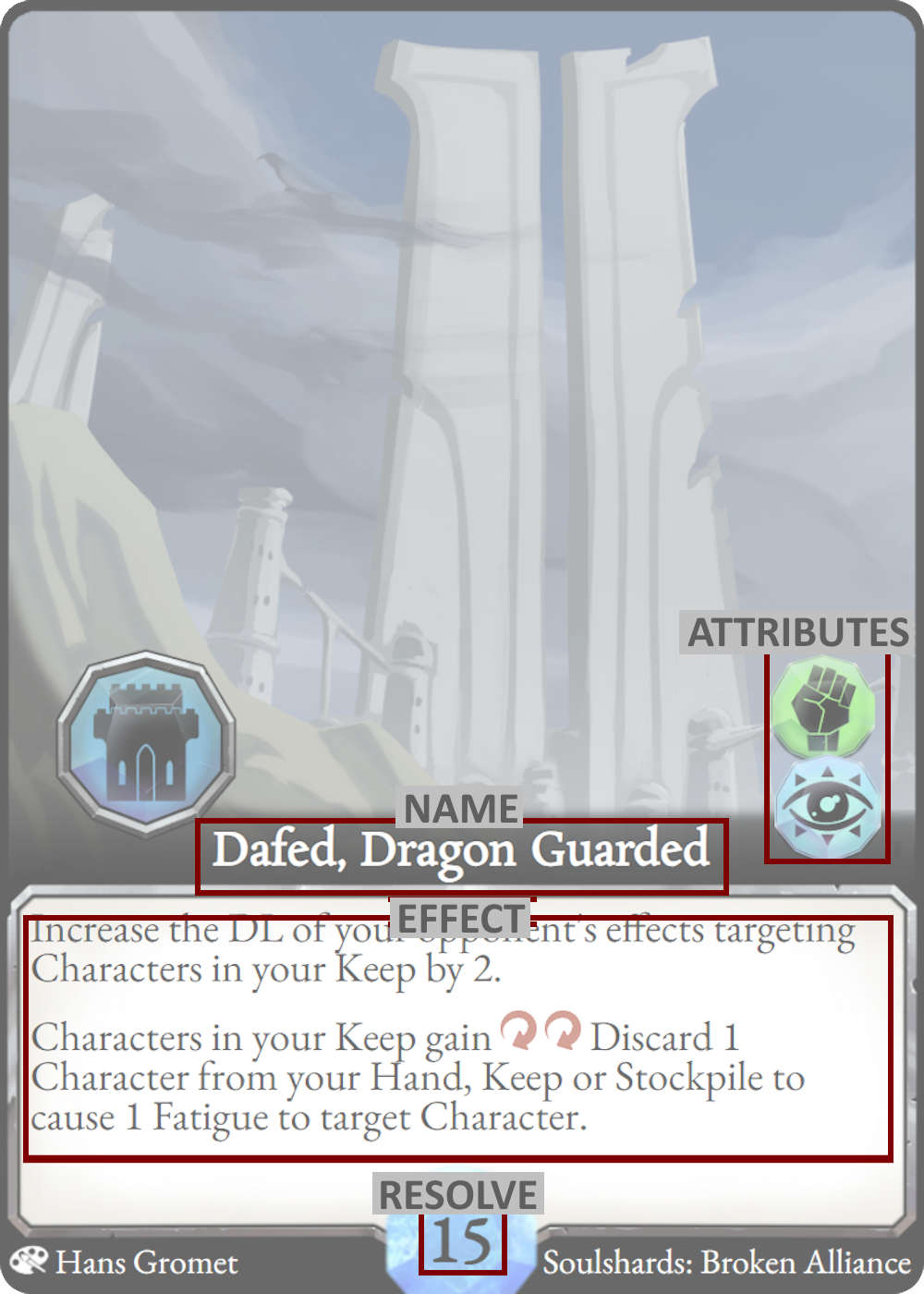
 Your Cities represent the alliance you fight to protect. They are the sources of your forces who will fight on the battlefield, the bedrock of the magical institutions that allow you to cast spells, and the territory of massive beasts that will join you in the fight.
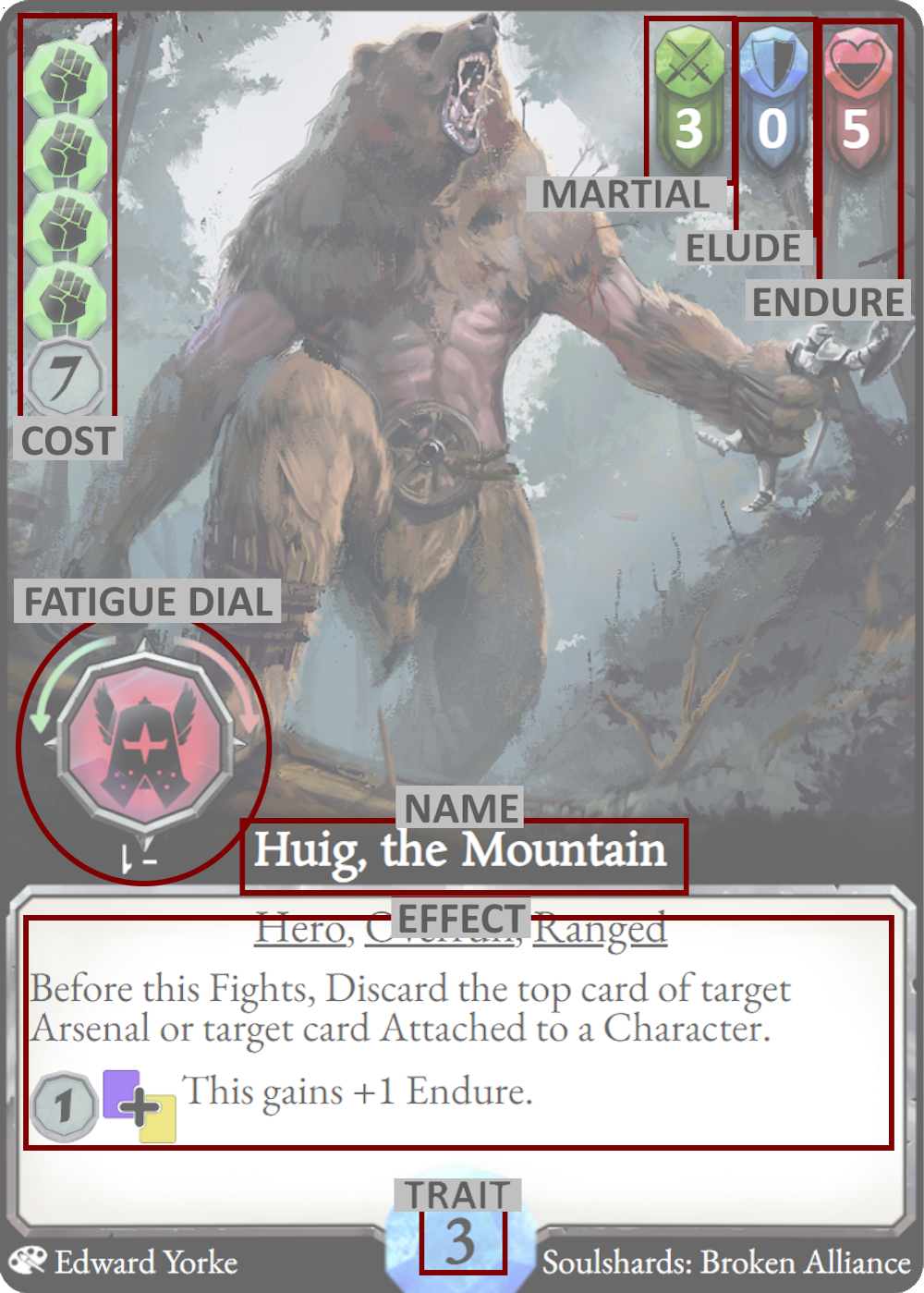
 Characters represent the various warriors, mages, and beasts that dwell within your city.
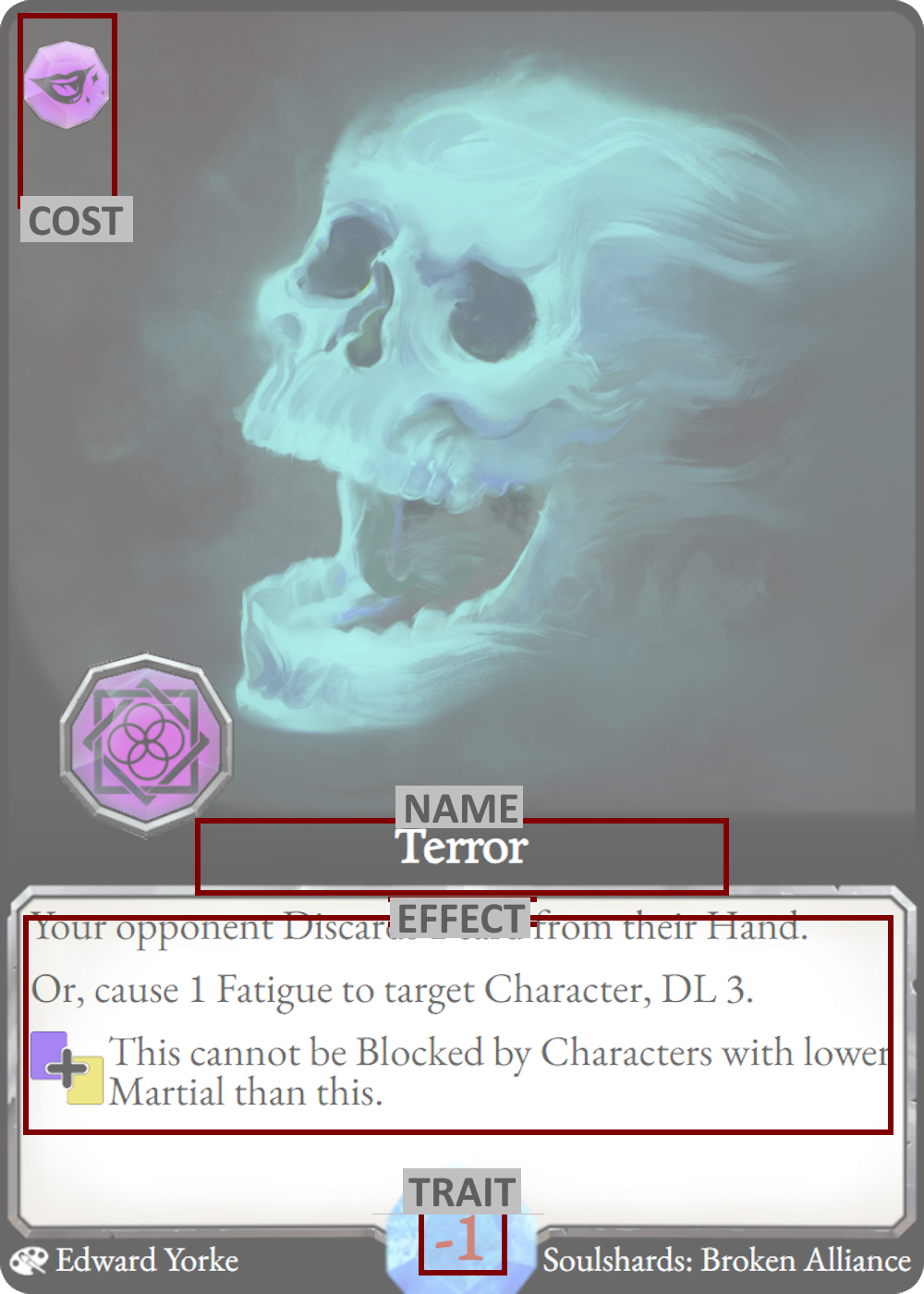
 Spells are powerful magics you can cast to aid your troops or hinder your opponent.
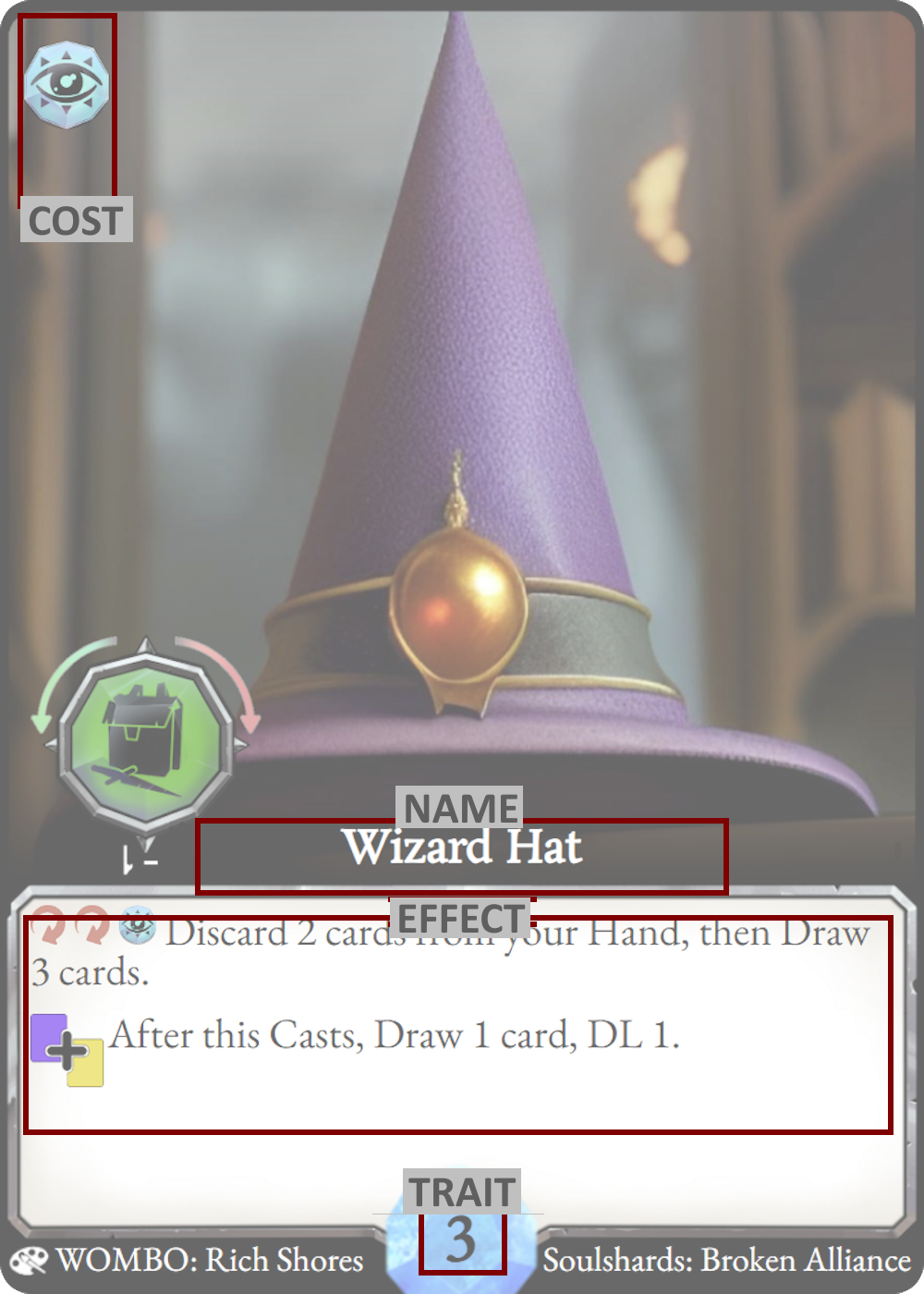
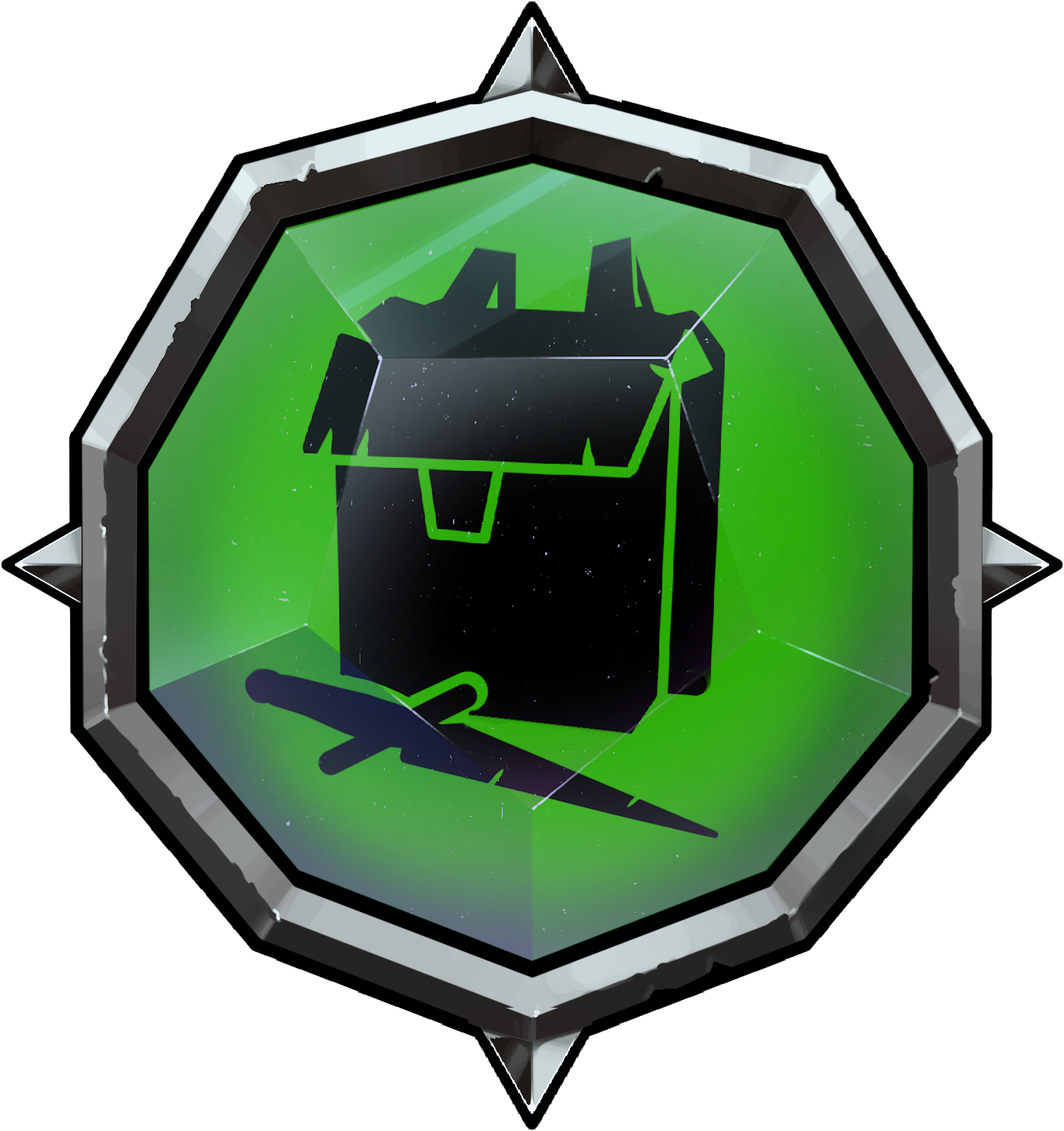 Gear are the various wondrous artifacts and technology available to your troops.




 All cards cost Souls to play and many effects cost Souls to activate. The number in the icon is how many Souls must be paid. If no number is shown, each icon is 1 Soul.
 The Fatigue icon is a cost of 1 Fatigue. Rotate cards 90 degrees clockwise for each Fatigue they have. If a card gains a fourth Fatigue, discard the card after the effect that caused the Fatigue is complete. If a card would have more than 4 Fatigue, discard it immediately, ending any actions or effects connected to it. Cards that can gain Fatigue have a red arrow over their card type icon pointing clockwise, and a green arrow pointing counterclockwise.
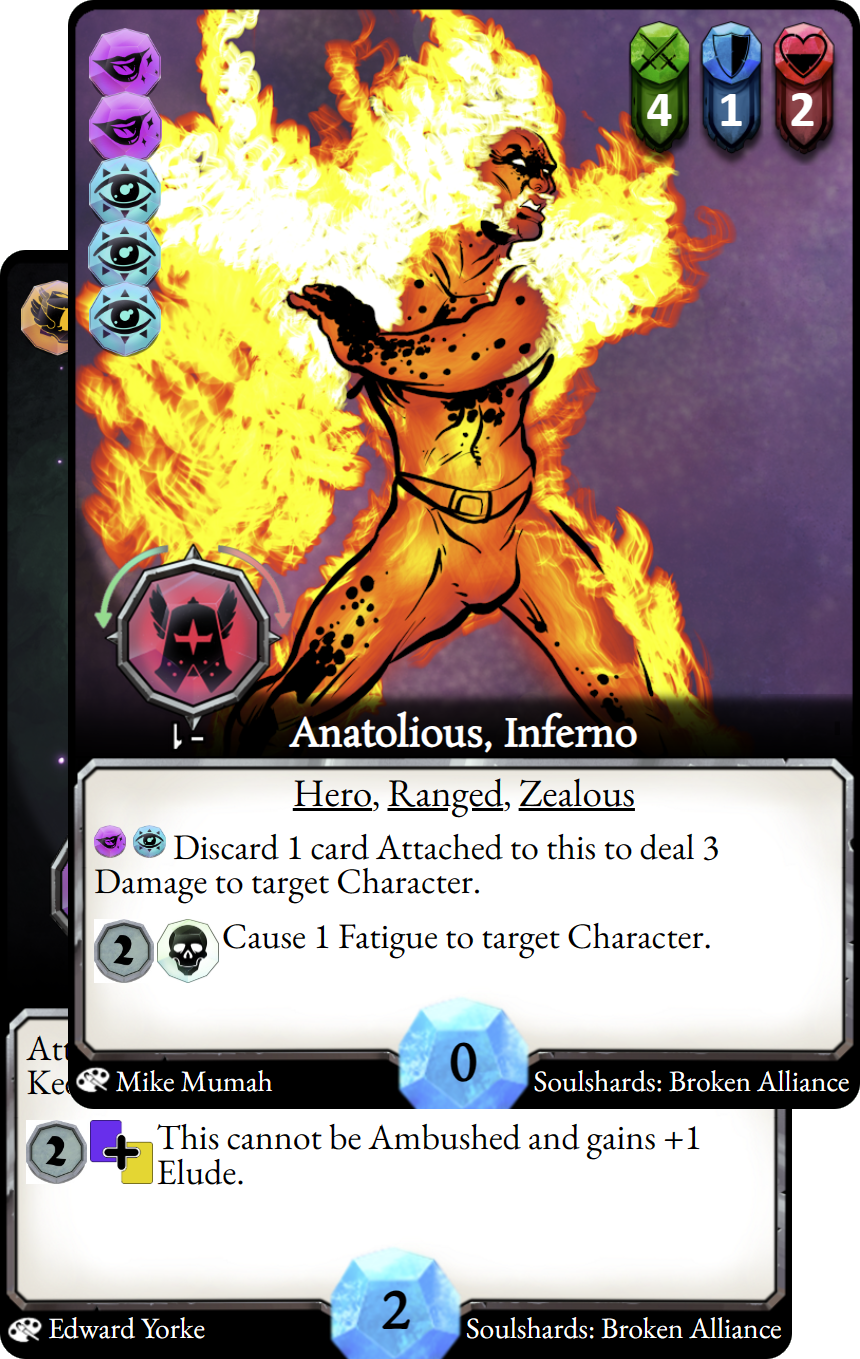 Cards can become Attached to Characters by a number of effects. To Attach a card, place it under the Character so that its effect can still be seen. Attached cards provide their Equip effects to the Character they are Attached to, but lose their own effects. They can be targeted by effects but cannot Move independently, act, or fight.